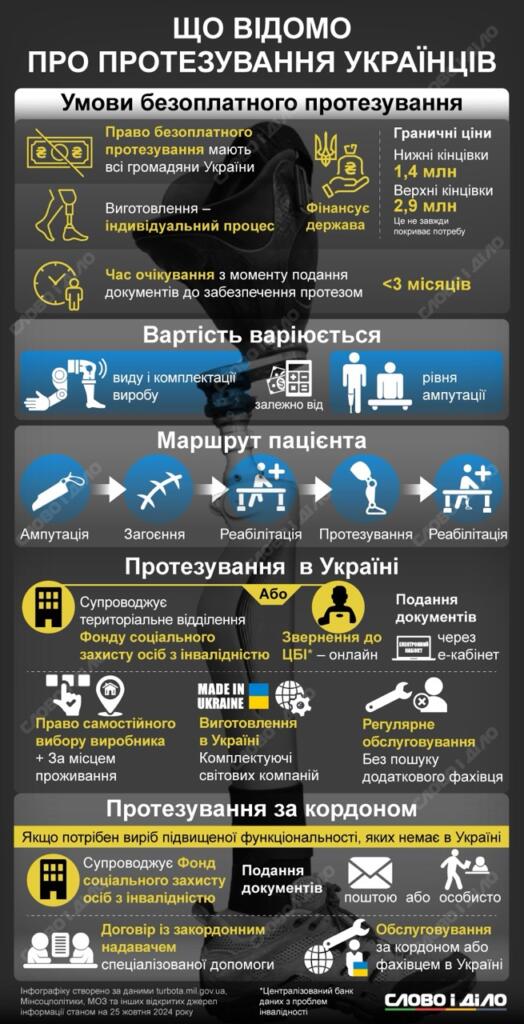


Prosthetics in Ukraine is free for everyone who needs it. The state covers the cost of installing quality prosthetics, as well as their maintenance and repair. You do not need to wait for disability status to receive a quality prosthetic.
The process of obtaining a prosthetic is multi-stage and involves doctors, rehabilitation specialists, prosthetists, and social workers. A patient with an amputation can rely on state support at all stages of starting a new life with a prosthetic.
We explain the path of a patient with an amputation to receiving a prosthetic.
STAGE 1: Amputation
Initially, all patients require surgery. Afterward, if there are no additional complications, the recovery stage begins. Simultaneously with medical care, rehabilitation assistance is provided. This period is called the acute phase. Its main goal is to prevent complications, such as congestive pneumonia, pressure sores, and thrombosis.
The scar gradually heals. The stitches are removed from the stump. A regular daily routine and quality nutrition become especially important. During this time, the patient is under the constant supervision and care of doctors.
STAGE 2: Healing
After limb amputation, there is a significant swelling of the stump and surrounding tissues. This is a normal reaction of the body to surgery.
During this period, contracture prevention (restriction of joint mobility) begins, and anti-edema therapy is conducted, which shows results in a few weeks.
STAGE 3: Pre-Prosthetic Rehabilitation
Once the scar has healed, pre-prosthetic rehabilitation begins. This process includes three important components:
- Physical exercises to maintain the range of motion in the joints,
- Compression therapy (bandaging with an elastic bandage or using a compression stocking),
- Scar massage, stump hygiene, and phantom pain management.
Proper compression improves blood circulation, reduces pain, and subsequently shortens the time needed for the stump to adapt to the prosthetic. Simultaneously, motor skills of the amputated limb are being restored.
During pre-prosthetic rehabilitation, a physical and rehabilitation medicine doctor or a social worker should provide the patient with comprehensive information about all manufacturers of rehabilitation aids and the necessary documents for obtaining them.
The choice of prosthetic manufacturer is up to the patient. The list of prosthetic enterprises can be found via the provided link.
STAGE 4: Prosthetics
An important stage of obtaining a prosthetic is the formation of an appropriate conclusion. This can be formulated by a medical commission, a multidisciplinary rehabilitation team, or specialists from the medical and social expert commission.
This document must consider all the specific needs and characteristics of the patient, indicating the features of the rehabilitation aid.
To submit documents for prosthetic provision, you can contact a social worker at the hospital, the Center for Administrative Services, or the regional office of the Social Protection Fund for Persons with Disabilities.
Documents can also be submitted through the electronic cabinet of the Centralized Disability Data Bank of the Ministry of Social Policy. Here is the list of required documents:
- Application form,
- For military personnel, a certificate from the unit commander about the circumstances of the injury,
- Conclusion of the Military Medical Commission (military) or MSEC/CCC/MDRC (civilian),
- Ukrainian citizen's passport (or a document replacing it),
- Certificate of identification code assignment,
- For military personnel, if available, submit a UBD certificate or veteran's military service certificate.
Regardless of the form of document submission for obtaining a prosthetic, the referral for prosthetics will appear in the electronic cabinet of the person with a disability.
You can contact the prosthetic enterprise in any way: online, by phone, in the hospital through a social worker, or through the head of the rehabilitation department.
Once the patient has chosen a prosthetic enterprise, interaction with the prosthetist begins: selecting the product's design, discussing possible components, etc.
The manufacture of the prosthetic can take an average of up to 45 working days.
All services and products are free for people and fully covered by the state.
STAGE 5: Prosthetic Rehabilitation
When the prosthetic is made, the stage of prosthetic rehabilitation and adaptation begins.
The prosthetist teaches the patient how to use the product, helps restore mobility, and get used to the prosthetic.
Receiving the prosthetic is confirmed by the head of the rehabilitation team's signature on the prosthetic acceptance report. Additionally, the process of fitting and accepting the prosthetic for use can be documented with photos and videos.
The collected data is transmitted to the Social Protection Fund for Persons with Disabilities. This allows the state to control the fact of prosthetics installation and improve quality control. However, consent for photo or video documentation is required from the person receiving the prosthetic.